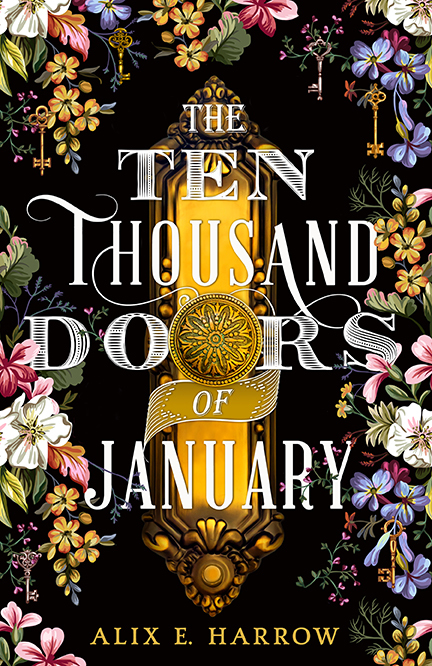
The Ten Thousand Doors of January is the story of January Scaller, a young woman of mysterious heritage who has grown up in the care of a Mr. Locke, a wealthy businessman and dedicated archeology collector, in Vermont in the early 1900s. January feels a bit as if she’s part of Mr. Locke’s collection—he often refers to her as a “unique specimen” or an “in-between sort of thing”—and isn’t sure how she fits into the world outside Locke House, just that she longs to explore it with her often-absent father, who serves as Mr. Locke’s field agent. But when she finds a strange book hidden away, January discovers there is more to explore than one single world; there are doorways to infinite worlds scattered in lost and lonely places, and they are tied to her in ways she can’t begin to imagine, but they are slowly and surely being destroyed.
I want to like this one more than I did. Which isn’t to say that I didn’t like it—I did—I just couldn’t find myself getting excited about it or engrossed in it the way I can with other books. Basically, when I finished reading, I was left with a feeling of “Well, that was okay.”
I suspect this may have been in large part due to the author’s choice of having our protagonist, January, looking back and telling the story, rather than living the story in the moment. It’s a subtle element in most places, because we don’t know when in time January is exactly, and so the narrative could catch up to her at any moment (unsurprisingly, it doesn’t until the very end), which keeps the tension intact and the stakes from falling completely, but we are reminded of it every so often when she shares thoughts with the reader like, “If you should ever be lucky enough to find that magical, fearful symmetry, I hope you’re brave enough to grab it with both hands and not let go. I wasn’t. Then.” (pg. 91). And then we remember that January is somewhere ahead of us, still alive and sounding like she’s fixed this mistake. The book-within-a-book aspect also slowed the story a bit, however interesting the backstory it provided may have been.
The concept, though, that most stories or legends, if taken as true or holding elements of truth, could be traced back to a moment of passing through a door or portal, and therefore could reveal points of passage between worlds, was interesting and I found the scholarly approach to fantasy inventive. The idea that these doorways are important because they allow for change, both for those who travel through them and experience other worlds and for the worlds themselves as travelers bring and take back new ideas and concepts from them, was a nice touch and gave the book a little deeper thematic resonance. While this could be applied to arguments about the importance of literal travel and exchange between cultures, given January’s specific ability to write doors open, I’d say the intended metaphor is more of an argument against book-burning/banning.
January herself is a character I could see some readers finding slightly annoying, with a rather flowery touch and a tendency to interrupt herself throughout the narration that makes her seem a bit precious, for lack of a better word, though she often refers to herself as “willful and temerarious.” She walked the line for me, and fortunately leaned just enough to the willful side in her actions that I could look past the poetic asides about the shapes of letters in her narration (though I do understand why, in the end, these asides would be important to her character).
The best character is Bad. He is January’s dog, and he is a bad dog in the best way, basically only minding her. They have a “Please Do Not Ever Bite” list between them, but as January describes, Bad sees it as “a fundamentally negotiable document” (pg. 346), because no one hurts his girl if he can help it. Unfortunately, we just don’t get enough time with the other characters to really connect with them in more than a surface way, though I do think both Samuel and Jane were likable; we just didn’t get a chance to dig deeper into them or see them shine. And I’ll let you judge January’s father for yourself (I will just say that he is the naive intellectual trope to a T).
All in all, I give The Ten Thousand Doors of January 2.5 stars out of 5. It just never fully sucked me in, but is an interesting idea and well-written, so other readers may have more luck with it.
 Christian Douglass Writes