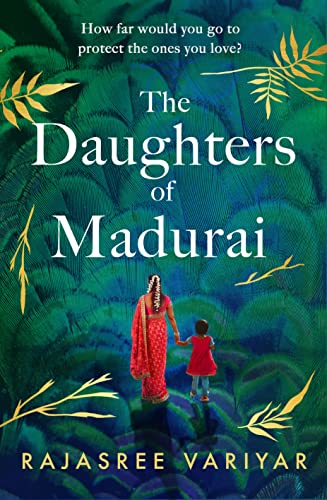
The Daughters of Madurai by Rajasree Variyar is an eye-opening and bittersweet exploration of difficult family dynamics and cultural expectations, and the high costs that come with them.
The book contains two separate timelines. The first timeline follows Janani, a young woman in 1992 Madurai, and to a lesser extent, Sanjay, a young electrical engineer and the oldest son in the home Janani cleans. Janani has given birth to three daughters, but daughters are not valued in this society, so she is only allowed to raise the first—the other two were killed at birth by her mother-in-law. Janani is pregnant yet again, but she is determined to keep this next child, no matter what. The second timeline focuses on Nila, a young woman in 2019 Sydney, on her way to India with her parents to see her dying grandfather, struggling with both the secrets kept from her about her family’s history, and her own secret that she doesn’t know how to share.
Because of the focus on pregnancy and motherhood, I made an assumption before reading that Nila’s secret was going to be an unplanned pregnancy, but it turned out pretty quickly I was wrong, she doesn’t know how to tell her parents she’s gay. This isn’t a spoiler, it’s given away early in her POV. I feel like my assumption would have been a more full circle opportunity for the plot, the actual “secret” just seemed to give Nila something else to think about other than not knowing her parents’ history, because otherwise her POV doesn’t have much going on.
Either way, the main story is Janani’s. You can guess pretty early on how the two timelines connect, and the story is less a question about what will happen, but why it happens and how it will unfold. Janani is a well-drawn character; you can feel her grief, anger, hope, and desperation all wrestling within her at different points. She isn’t trying to be rebellious or different, she just wants to love and raise all her children. Unlike the reader, she doesn’t have any idea of how her story may end, but she forges ahead anyway, taking gradual but determined steps off the traditional path, first by saving up her own money in secret, then by deciding to continue on with her latest pregnancy even knowing it is a girl, until finally she reaches the literal point of no return: she will not be allowed back inside her husband’s house if she brings another daughter with her.
I’ve seen some other reviews mention the language isn’t accurate, and often confusing, especially in regards to the multiple variations of relational names, like aunt, brother, or sister, present in Tamil and Malayalam. I cannot speak to the accuracy, but I found it reasonably straightforward to determine when a character was being called by a title or term of endearment vs. their actual name, as we see the core members of each family often enough to know who is who and who calls who what, and it didn’t bother me that I didn’t know exactly what the terms meant. In the few larger family scenes where extended family was mentioned, I wasn’t worried about keeping track of who was who or what their exact relation was because I knew the names dropped weren’t key characters.
All in all, I give The Daughters of Madurai 3.5 stars. It’s a heavy read at times, but a compelling one.

